The product is the chain of evidence
Generating an image is only one event in a usable content workflow. A collaborator also needs to know which product facts were supplied, which source assets were used, what the queue produced, what automated rules observed, who selected the final result, and what was ultimately packaged.
FashionAI Studio makes those decisions visible instead of collapsing them into a single “AI completed” state.
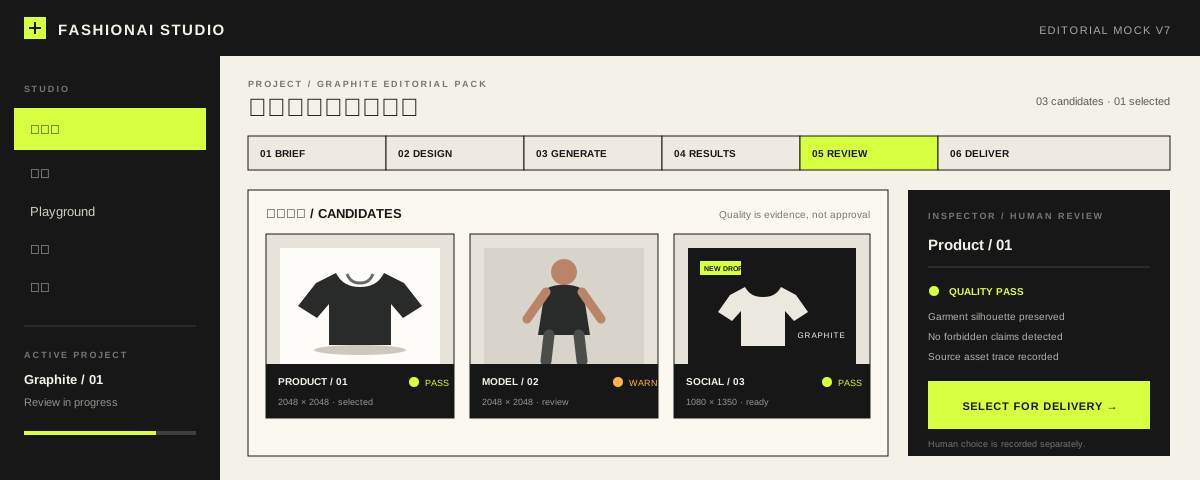
Brief → Design → Generate → Results → Review → Deliver. Every stage can be revisited, and every missing prerequisite is explained in place.
Six stages with different responsibilities
- Brief / Product facts. Record the mode, target market, garment facts, and forbidden claims before generation begins.
- Design / Source media. Upload front and back views, reuse templates, and place a transparent mark on a deterministic canvas.
- Generate / Production plan. Choose the fast three-image chain or assemble a custom deliverable pack.
- Results / Candidate output. Follow real queue state, inspect candidates, download an item, or retry it independently.
- Review / Human decision. Read executable
pass,warn, andfailevidence, then make an explicit selection. Risky results are never preselected. - Deliver / Traceable package. Export only selected items with a readable directory preview and
manifest.json.
The active stage is stored in the URL, while review selections are scoped to the project in sessionStorage. Desktop uses a primary canvas and sticky Inspector; the 390px layout keeps the same path with a collapsible Inspector and sticky action bar.
One original input-to-delivery fixture
The public Mock now uses one coherent, unbranded editorial set: a graphite garment input, a transparent geometric mark, a white-background product candidate, a fictional model candidate, and a vertical social candidate.
Every public file ships with its dimensions and SHA-256 checksum. The repository also includes the generation notes, prompts, and a plain-language AI declaration. These assets are demo evidence—not a customer case or a claim of commercial performance.
Three signals that the interface never conflates
| Signal | What it proves | What it does not prove |
|---|---|---|
| Task succeeded | The configured generation job returned an output. | That the output is accurate or publishable. |
| Quality conclusion | Executable rules recorded a pass, warn, or fail observation. |
That a person approved the result. |
| Human selection | A reviewer deliberately included that candidate in this delivery. | That rights or product facts no longer need final verification. |
This distinction is the core interaction decision. It keeps retries, warnings, and final delivery legible to both product and engineering reviewers.
Boundaries ship with the output
The Mock remains browser-local and does not call a paid model. Real API, authentication, database, queue, quality, and export contracts remain compatible with the earlier implementation. Cost is shown only when a task recorded one; otherwise the interface says it is not configured. Upload rights and final commercial review remain the operator’s responsibility.
The result is a much stronger collaboration surface: someone can open the public product, inspect a complete workflow, verify the evidence pack, and discuss production changes without guessing which parts are real.